Background
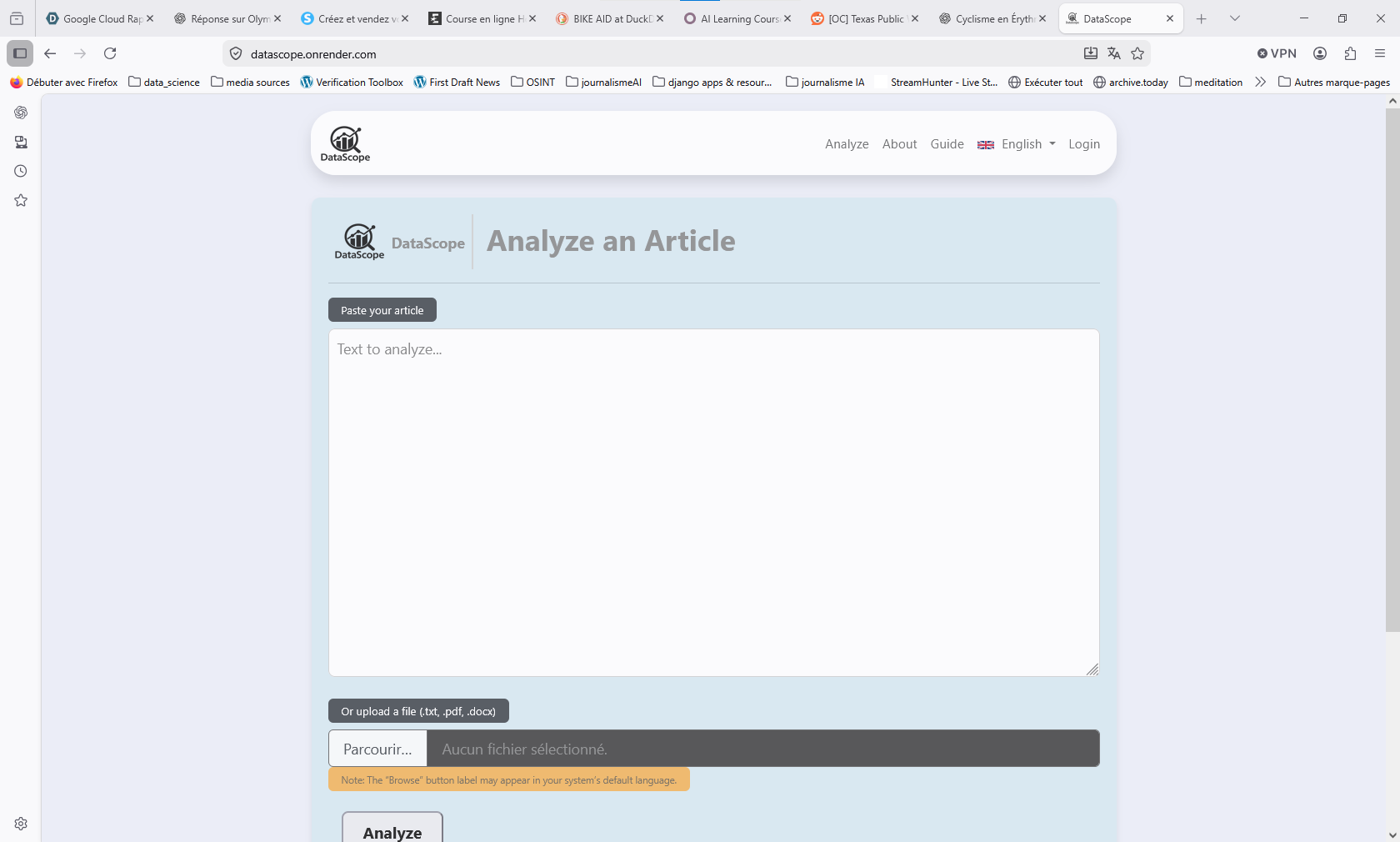
Datascope is a web application designed to help journalists uncover the “data” potential hidden inside an article. The tool combines local Natural Language Processing (NLP) with generative AI to extract key entities from a text, compute a “datafication” score, suggest editorial angles, and recommend relevant open data sources.
The goal is to provide a lightweight assistant that supports the investigation and ideation phase, turning a raw article into actionable leads for data journalism.
🔗 Live app: datascope.onrender.com
Features
- Entity extraction: automatic detection of people, places, dates, numbers and organisations via local NLP
- Datafication score: a synthetic indicator that estimates how much data potential an article holds
- Editorial angle suggestions: LLM-powered generation of journalistic angles
- Open data sources: recommendations of relevant APIs or datasets to explore further
- Multilingual support: analysis of articles in French and English (selectable through the UI)
- Multi-format input: handles raw text, PDF files and Word documents
- Export: download the analysis as Markdown or JSON
Tech stack
Backend and NLP
- Python 3.12 and Flask for the web application
- spaCy for local language processing (
fr_core_news_sm,en_core_web_sm) - OpenAI API for editorial angles and content suggestions
- pdfminer and python-docx for multi-format input handling
Quality and testing
- pytest for unit and integration tests
- Test coverage above 80% (
pytest-cov) - black for code formatting
Deployment
- Containerised with
Dockerfileanddocker-compose.yml - Deployed in production on Render.com
- Simple email-based authentication
Architecture
The project is built around clearly separated modules:
app/: Flask routes, views and Jinja2 templatescore/: processing pipeline (NLP, LLM calls, parsing, exports)tests_pytest/: unit and integration testsuploads/: temporary storage for submitted articles
This separation allows the analysis layer (NLP + LLM) and the web interface to evolve independently.
Project status
Deployed and live. The application is publicly accessible and already covers the main use cases: multi-format import, bilingual analysis, angle generation and export. Future iterations will focus on enriching the catalogue of open data sources proposed and refining the datafication score.
Useful links
- Live app: datascope.onrender.com
- Source code: github.com/hericlibong/datascope_project