Background
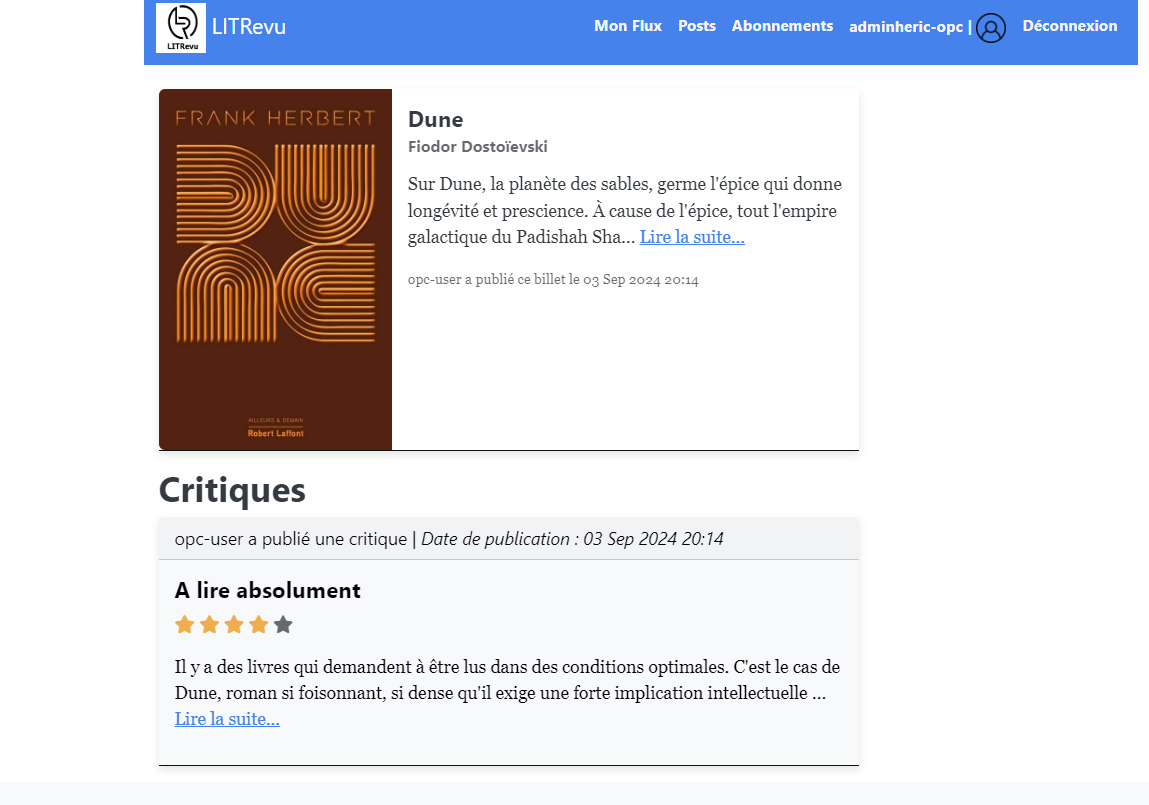
LitRevu started as a training project, with one clear goal: put the Django framework into practice on a complete, end-to-end web application. The idea was to build a small community platform around reading, where users can either ask for recommendations or share their opinion about a book or an article.
The need is straightforward — let readers request or post reviews, follow other users and find every relevant publication in a personal, chronological feed.
Beyond the deliverable, the project is above all a hands-on playground for Django: relational models, authentication, forms, function- and class-based views, templates, and a project layout designed to scale and stay maintainable over time.
Project overview
LitRevu is built around three core use cases:
- Request a review by posting a ticket about a book or an article.
- Publish a review, either in response to an existing ticket or as a standalone piece on a given work.
- Discover new reads through the publications of the users you follow.
Key features
- Ticket creation: users can open tickets to request a review of a specific book or article.
- Review publication: write a review in response to an existing ticket, or independently on any work.
- Follow system: each user can follow other accounts to surface their publications.
- Personal feed: a chronological dashboard mixing tickets and reviews from followed accounts together with the user’s own publications.
Authentication and demo
A demo SQLite database ships with the project, along with a test account (opc-user / demo) so the app can be explored without any prior setup.
Tech stack
Backend
- Python 3.10+ and Django for the whole application
- SQLite by default for an easy onboarding, PostgreSQL planned for production
- Django REST Framework (in progress) to expose user profiles through an API
- Native Django authentication, extended by a
Profilemodel (bio, picture, website)
Frontend
- Django templates with layout inheritance
- Custom HTML and CSS, no heavy JavaScript framework
Infrastructure and quality
.envfile for sensitive configuration (secret key,DEBUG,ALLOWED_HOSTS)- Docker +
docker-compose(in progress) to orchestrate the Django app and the PostgreSQL service - GitHub Actions planned to automate tests and deployment to Render
- Unit and functional tests being added to secure future iterations
Project status
Refactoring in progress. The first functional version covers the core use cases (tickets, reviews, follows, feed). An active roadmap is driving the next steps:
- Migration from SQLite to PostgreSQL in production
- Richer user profiles (bio, picture, personal website)
- RESTful API on profiles via Django REST Framework, secured with tokens
- Full Docker containerisation
- CI/CD with GitHub Actions deploying to Render
- API documentation (DRF Spectacular / Swagger) and stronger test coverage
Detailed task tracking lives in the associated GitHub Project.
Useful links
- Source code: github.com/hericlibong/Web_Django_App_LitRevu
- Project board: GitHub Project #4